There is no “right” way to react when your child receives an autism diagnosis.
Relief. Validation. Grief. Acceptance. Uncertainty. Hope.
Sometimes all of those emotions exist at the same time.
This is a parent’s perspective, not that of the child who received the diagnosis. Their story is theirs to tell, not mine. This is simply an honest reflection on what the experience has felt like for us as parents.
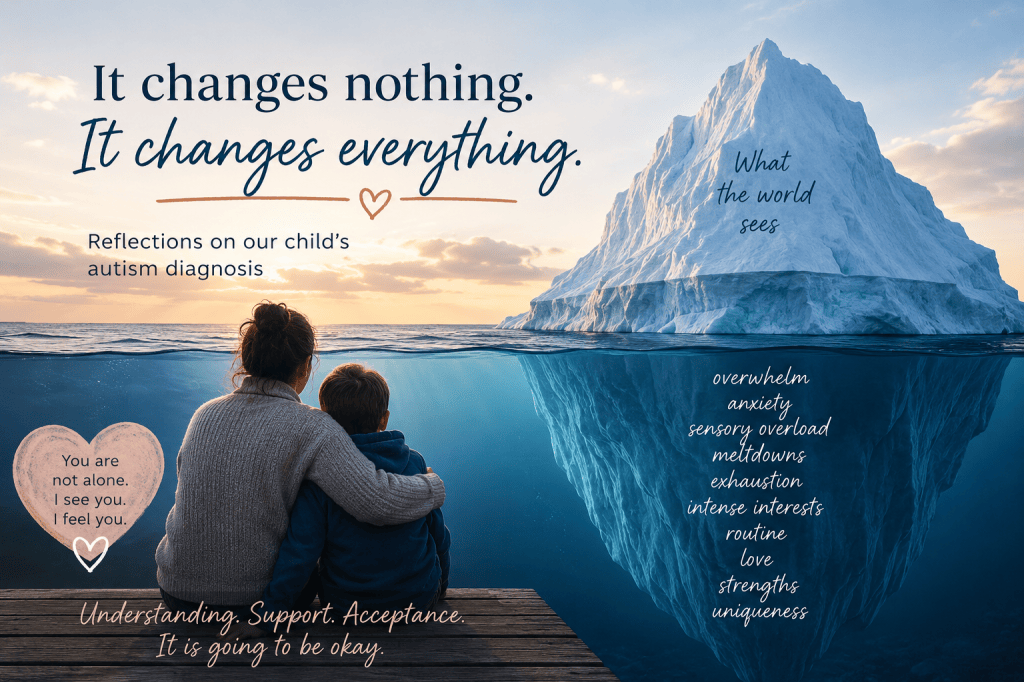
It changes nothing. It changes everything.
Since our child’s autism diagnosis, I’ve found myself sitting in two seemingly contradictory camps.
The diagnosis changes nothing.
The diagnosis changes everything.
Both statements are true.
It changes nothing because our child is exactly the same person they were before the assessment. The diagnosis hasn’t altered who they are, what they love, or how deeply we love them.
Yet it changes everything because suddenly years of wondering, adapting, questioning ourselves, and trying to make sense of certain behaviours begin to fit together.
There is a reason.
There is an explanation.
And, perhaps most importantly, there is a way forward.
Looking back
People often ask whether I wish we’d known sooner.
Maybe.
But then I ask myself another question: what would we actually have done differently?
Honestly, probably very little.
Without a diagnosis, we had already adjusted our parenting. We’d tweaked expectations compared with our other children. We’d relaxed some boundaries that, for this child, simply weren’t the hill to die on. We had instinctively adapted because that’s what parenting this particular child required.
The diagnosis hasn’t rewritten our parenting. It has simply validated the decisions we’d already made.
Our child also coped remarkably well for many years. It wasn’t until more recently, when feelings of overwhelm became increasingly difficult to manage, that they themselves began questioning whether they might be neurodivergent. We supported their decision to seek answers—not because we wanted a label, but because they wanted clarity.
The fear of labels
If I’m honest, I wasn’t always convinced that pursuing a diagnosis was the right thing.
I worried about stigma.
I worried about labels.
I worried that people would see the diagnosis before they saw the child.
I worried it would somehow define them.
And because we’d already adapted our parenting, I wondered whether having a diagnosis would actually change anything.
Now I realise that while it doesn’t change who our child is, it does change the support available to them.
Their needs are now recognised.
Those they choose to tell may better understand why some situations are difficult.
Most importantly, the assessment gives us something practical to work with. It helps identify the areas where life is genuinely harder for them than it might be for a neuro typical person, allowing us to seek the right support—not to change who they are, but to help them develop skills, confidence, and self-acceptance.
For us, “What now?” looks like counselling.
Counseling for our child.
Support for siblings to help strengthen understanding and relationships.
Support for us as parents, so that we can continue learning how to meet our child’s needs in the healthiest way possible.
“But I never would have guessed…”
One comment we’ve heard more than once is:
“I’m really surprised.”
Masking is a real thing.
Many people with autism learn to observe, copy and rehearse social behaviours so effectively that the effort behind it remains invisible to everyone else.
What people see isn’t always the full picture.
Understanding diagnosis
Many of us can recognise one or two autistic traits in ourselves from time to time. That isn’t the same as having autism.
An autism diagnosis is based on a comprehensive assessment, completed by experienced professionals using recognised diagnostic criteria, that looks at how those characteristics come together and how significantly they affect everyday life.
A fellow parent once described it beautifully using the image of a star.
Most people would probably have the occasional point sticking out here or there.
But for an autism diagnosis, enough points align to create a clear star.
I found that image incredibly helpful.
Even then, I wasn’t convinced our child would meet the threshold before the assessment feedback.
When the diagnosis was confirmed, it still took time to process.
Autism doesn’t always look how people expect
Our child masks well.
They’ve learned behaviours for many social situations.
From the outside, they don’t fit many people’s outdated stereotype of what a child with autism “looks like.”
That’s because autism doesn’t have one look.
Every person with autism is different.
Some differences are immediately visible.
Others remain almost completely hidden.
The iceberg
The image that keeps coming back to me is an iceberg.
Every iceberg is different.
Above the water is the part the world sees.
The conversations.
The smiles.
The school day.
The social interactions.
But beneath the surface lies the part very few people witness.
The exhaustion.
The overwhelm.
The anxiety.
The shutdowns.
The meltdowns.
The situational mutism.
The sensory overload.
The repetitive conversations.
The intense interests that can dominate family life.
The food phases.
The need for routine.
The distress when that routine changes.
The hurtful comments spoken in moments of dysregulation that still sting, even when you know they aren’t truly meant.
It’s this hidden part that prompted me to write this.
To those parents living with the unseen part of the iceberg…
I see you.
I feel you.
And I’m sending you warmth, love, and the biggest virtual hug.
Because you are not alone, even when it feels like you are.
Parent fatigue is real
There are hard days.
Really hard days.
The walking on eggshells.
The endless negotiations.
The beige food.
The scripts.
The routines.
The emotional energy it takes to help someone regulate while trying to regulate yourself.
Parent fatigue is absolutely a thing.
But so are the wonderful days.
The funny days.
The brilliantly unique conversations.
The fierce passions.
The incredible honesty.
The creativity.
The humour.
The kindness.
Their uniqueness and strengths outweigh the difficult days many times over.
No regrets
We don’t feel guilt.
We don’t feel blame.
We believe we made the best decisions we could with the information we had at the time, always involving our child as much as was appropriate.
Did we suspect?
Of course we did.
Was exploring a diagnosis ultimately the right decision for this child?
Absolutely.
But I also believe we did it at the time that was right for them.
Another of our children may also meet the threshold for an autism diagnosis.
They’ve chosen not to explore that at this stage, and we completely respect that decision.
Part of their hesitation comes from worries about future employment and the stigma that still exists.
Again, that is their story—not mine—to tell, if they ever choose to.
“So what now?”
I’ve spoken to many parents who describe reaching the end of the assessment process and thinking:
“So what?”
Or…
“What now?”
For us, the diagnosis hasn’t changed how much we love our child.
It hasn’t changed our hopes for them.
We still want them to be happy.
Healthy.
Resilient.
Confident.
And able to fulfill whatever potential they choose to pursue.
What the diagnosis has changed is us.
It has replaced years of second-guessing ourselves with understanding.
It has lifted the fog that surrounded so many moments in the toddler years and beyond.
It has given us confidence that the adaptations we’d already made weren’t us getting parenting wrong—they were us responding to the child in front of us.
Most importantly, it gives us a roadmap.
Not to change who our child is, but to help them navigate a world that isn’t always designed with their needs in mind.
And perhaps that’s the greatest gift the diagnosis has given us.
Not answers to every question.
But permission to stop asking ourselves whether we were imagining it all.
It has reminded us that our child has never needed fixing.
Only understanding.
And perhaps that’s what this whole journey has really been about.
It is going to be okay.

