This is a personal experience post. It describes how we did things — not a recommendation or blueprint for how anyone else should approach home education. Rather, it’s a success story of taking a chance on a different path, one that worked for our family, and one I feel both relieved and proud of.
The big news
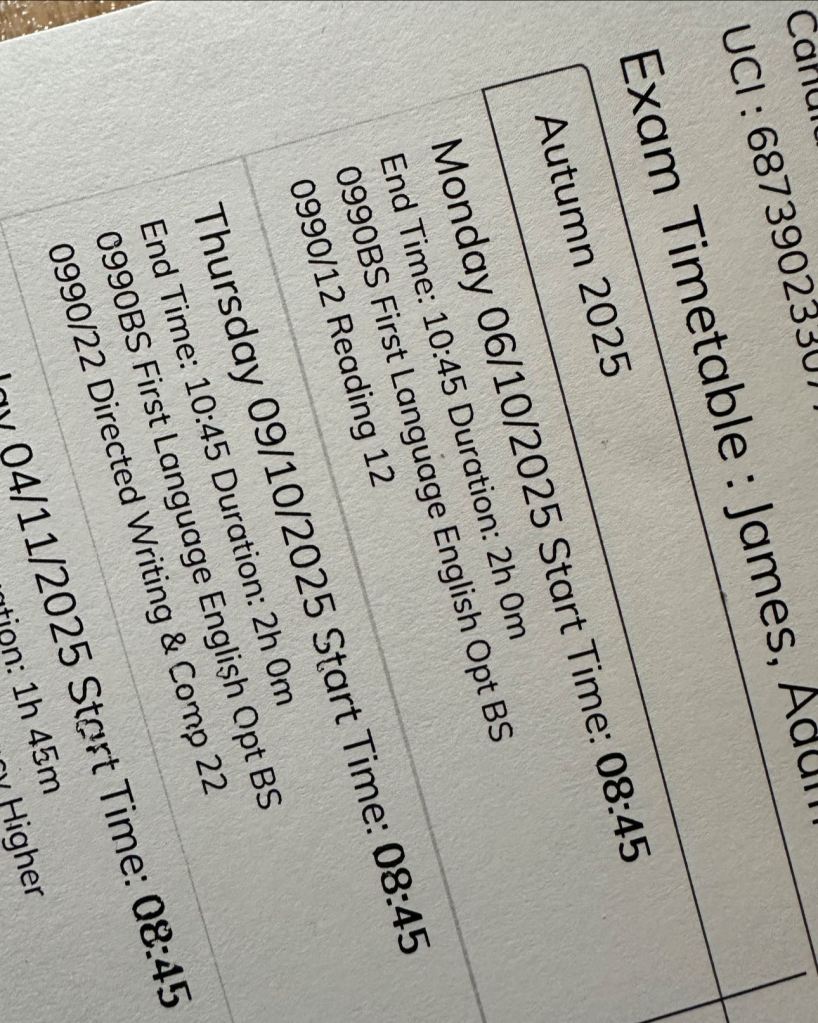
This week, A1 received his English GCSE result, meaning he has now met the conditions of the college offer he received earlier this year. He currently has six GCSEs completed, with two more exams to sit in the spring.
Looking back over the past two and a half years, I reflect and share some thoughts for anyone considering home education at Key Stage 4 (ages 14–16).
Legal requirements (and what they really mean)
Key Stage 4 is the final stage of compulsory full-time education. There is an expectation that a child is receiving a suitable education, but there is no legal requirement to follow the National Curriculum or to enter a child for GCSEs.
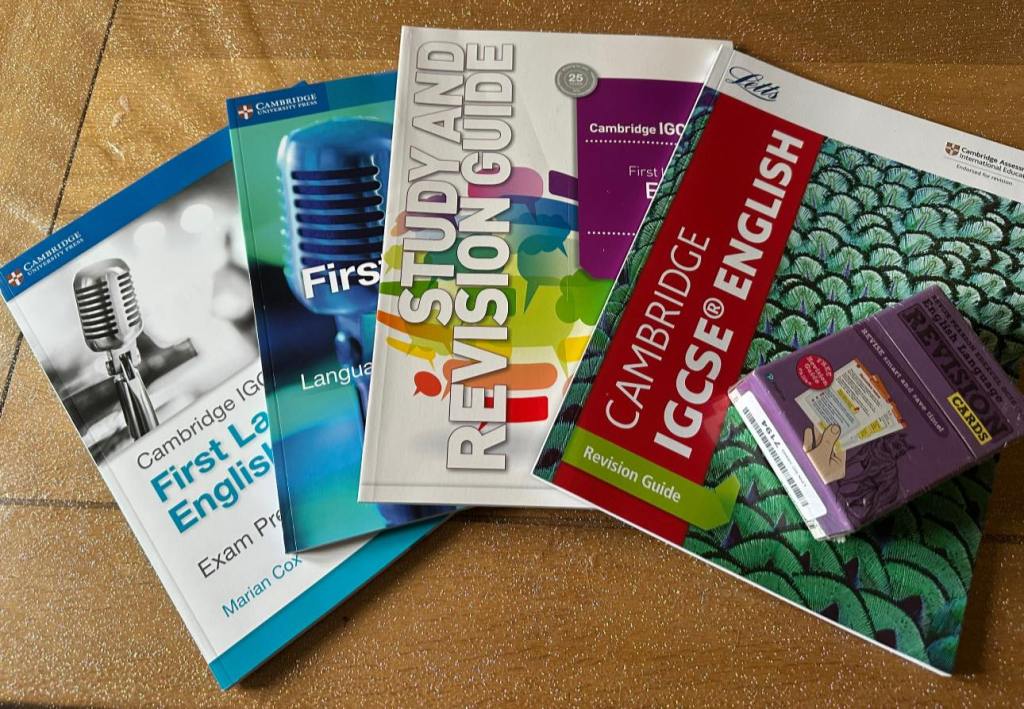
There is no reason why a home-educated child cannot spend time learning new languages, studying coding or IT, or focusing on life skills etc. In A1’s case, he has always had a strong interest in engineering. With this clear direction, and with nine years of experience in the school system behind him, we all agreed that working towards GCSEs via a recognised exam board was the right route. This gave us a clear syllabus, textbooks, and externally recognised exams to work towards.
Personality, ability, and relationship matter
We have two children who could not be more different. One is currently able to learn and manage in conventional schooling. The other simply couldn’t. Your child’s personality, and your relationship with them, must be a central factor in deciding whether home education is viable.
I cannot imagine home educating A2.
And A1’s natural academic ability helped significantly. I am not trained, nor equipped, to teach a child with complex learning difficulties or additional needs.
That said, A1 and I have had many moments…..challenging ones included. But our personalities mean we are able to work through difficulties with trust, honesty, and communication. Motivation and commitment were not always consistent on either side, and there were periods where drive was low. That is part of the reality of doing this.
Project management (my actual contribution)
I have huge respect for families who home educate younger children. I could never teach a child to read or write. I also cannot teach maths, and it seems, certainly not chemistry either.
What I can do is project manage. That turned out to be enough.
We took each iGCSE syllabus and mapped topics across the academic year using a spreadsheet, factoring in time for revision before exams. This structure gave A1 clarity without over-scheduling and allowed flexibility when life happened.
The local authority has been our friend
It is important (and reassuring) that the local authority fulfils its duty of care by following up on children in home education. Proportionate oversight helps ensure children are safe, supported, and receiving a suitable education, while reinforcing shared responsibility for safeguarding.
In our experience, the local authority has checked in with us, encouraged us, signposted services and resources (incl. youth groups, career events, vaccination programmes) and helped with exam arrangements.
They have never requested reports or coursework. Following a recognised exam board syllabus clearly helped demonstrate the educational provision we were offering, and the relationship has been positive throughout.
What to study — and how much
We are based in Wales. Had A1 remained in school, he would have been on track to complete possibly 14 GCSEs, including Maths and Numeracy, English Language and Literature, Welsh, Religious Education, Combined or Triple Science, Welsh Bac and several optional subjects. However, I am yet to find a college, sixth form, or apprenticeship programme that requires anywhere near that number of GCSEs.
Most require five GCSEs at grade C or above and this ncludes Maths and English. Some courses require higher grades or specific subjects, but no one has asked for fourteen GCSEs.
Typically, students take 6–9 GCSEs over two years, with an estimated 120–180 hours per subject.
On that basis, 6 GCSEs ≈ 900 hours total which is around 8–9 hours per week over a year
This is, of course, a rough estimate, and it’s worth repeating the home education caveat:
All justified time can reasonably be considered learning time, as learning occurs in many contexts, not solely within formal lessons.
Choices, choices
One of the great advantages of home education is choice. A1’s interest in engineering meant he could study Physics and Computer Science, alongside English and Maths, without being limited by a school GCSE offer / selection.
One of the disadvantages is also choice, or rather, access.
A1 would have loved to continue studying Welsh, but practical exam requirements made this difficult outside school. Ironically, the nearest viable option would have involved travelling to an international language centre in Bristol, which wasn’t feasible for us.
Similarly, some creative subjects (such as textiles) are harder to access through international exam boards, and subjects like Chemistry are undoubtedly easier (and I am sure, more enjoyable) when experiments can be carried out in a lab.
GCSE vs iGCSE
GCSEs and iGCSEs are equivalent qualifications and are equally accepted by colleges, sixth forms, and universities. GCSEs are typically UK school-based and may include coursework.
iGCSEs are usually 100% exam-based and internationally oriented. For our circumstances, iGCSEs worked best.
Getting started
We withdrew A1 from school at the start of Year 9. The reasons are personal to him and not for sharing here, but school life was no longer working, and we deregistered.
For the first half of Year 9, very little formal education took place. De-schooling, recovery, and appointments took time. Educationally, we focused on short courses and online content to maintain some routine without exam pressure.
Routine has remained a challenge throughout this journeyand there were times I abandoned it entirely in favour of a “get the work done” approach.
In the second half of Year 9, A1 chose to sit Computer Science iGCSE. This was a confidence-building step (for him and for us). He achieved a B grade, proving that exams were possible and giving us momentum going forward.
Resources and support
The exam board provided a clear syllabus, textbooks, and workbooks. Because Computer Science was an area we had some background in, we could offer direct support.
For almost everything else (and as working parents) we relied heavily on external resources and our wider village. Without them, A1 would not be where he is today. Home education groups (both national and local) were invaluable for understanding how home education works, accessing free resources, reviewing online colleges and navigating deregistration.
If we were doing this again, I would seriously consider an online college offering structured courses and tutor support in its entirety for home education. At the time, A1 wasn’t keen, so we built our own system instead. Financially this can also be costly and a barrier.
By Years 10 and 11, A1 was studying 3–4 iGCSEs per year, with weekly tutor support, videos, flashcards, and past papers and clear weekly expectations.
Socialising (the big worry)
This is often the first concern people raise, and one we found surprising. A1 is extremely social. He volunteers weekly with local engineering-related charities, mixes with people of all ages, maintains friendships with peers, cycles off on adventures, travels by train, and explores local history. His creativity shows up in woodworking, 3D modelling, and online game design.
Most importantly, he has had time to heal, build resilience, and rediscover enjoyment in learning and life. He is content, motivated, and ready to re-join his peers at the college/sixth form stage, all without having been placed at any educational or social disadvantage.
And we’ll take that win.
 Blog life